How to Register a Logistics or Delivery Company in Nigeria
CAC registration first, then the NIPOST courier licence, rider permits, vehicle papers and insurance. What each one is and the order to do them in.
About FastCAC: FastCAC isn't a CAC agent. It's a registration platform built by DigitalAbode (RC 8561321), a registered Nigerian technology company, that files your application directly with CAC.
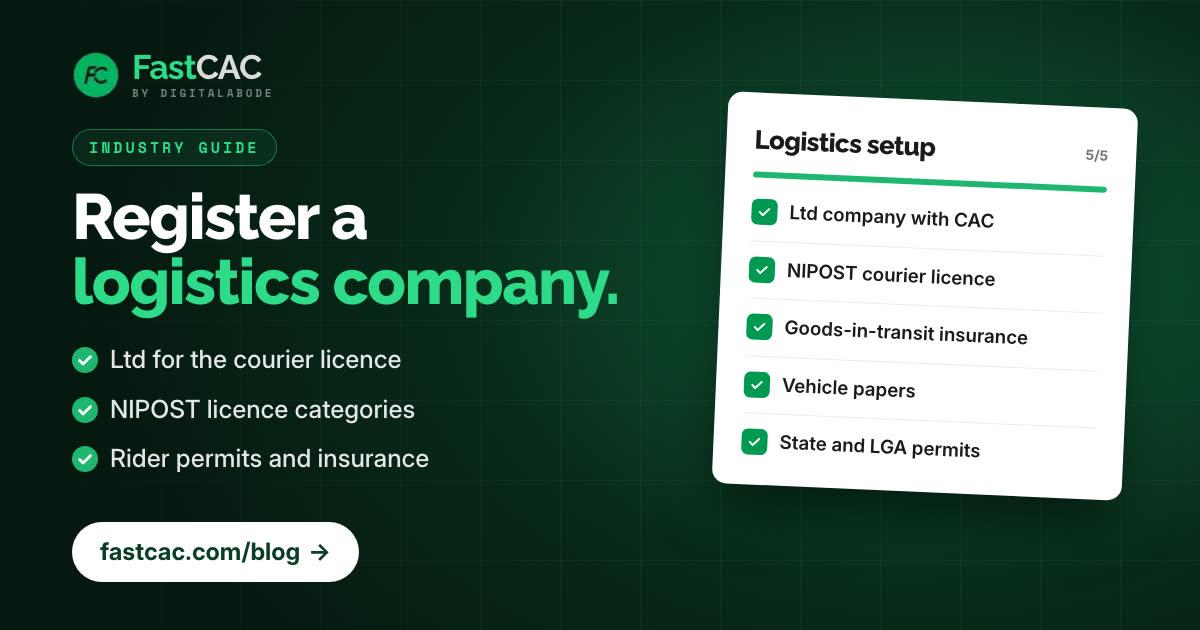
Dispatch bikes, van deliveries, haulage, warehousing: logistics is one of the easiest businesses to start in Nigeria and one of the easiest to start wrongly. Plenty of operators run for months on a WhatsApp number and a bike, then hit a wall when a big client asks for their CAC certificate and NIPOST licence.
This guide covers the order things happen in: register the business with the Corporate Affairs Commission (CAC), get the NIPOST courier licence, sort out your riders and vehicles, then stay on the right side of the tax authority. It's general information, not legal advice, and regulators change their rules, so confirm the current position with each agency before you pay for anything.
1. Business Name or Ltd?
CAC offers two structures most small businesses choose between. A business name is cheaper and simpler, but you and the business are legally the same person. A private limited company (Ltd)is a separate legal person with its own liability, and it's the structure most corporate clients and regulators expect. Our business name vs limited company guide compares them in detail.
For a courier business, the law points to Ltd
Section 43 of the Nigerian Postal Service Act (as published in the Laws of the Federation 2004) says a person may operate a courier service only if it is registered as a company under the Companies and Allied Matters Act and licensed by NIPOST. If you plan to deliver other people's parcels and want a NIPOST licence, register an Ltd. A business name can still make sense if you're testing the idea or only moving your own goods, but expect to upgrade.
Already trading as a business name? You can move to an Ltd later. See how to upgrade a business name to a limited company.
2. The NIPOST Courier Licence
The Nigerian Postal Service (NIPOST) regulates courier and logistics operators through its Courier and Logistics Regulatory Department (CLRD). Its own FAQ says it's illegal to run a courier, express, dispatch, delivery, distribution or logistics business in Nigeria without a NIPOST licence, and NIPOST runs periodic clampdowns on unlicensed operators.
Licence categories
NIPOST lists four: International, National, Regional and State/SME. The category depends on where you operate. Most new dispatch and last-mile businesses start at State/SME, the cheapest tier.
Where to apply
Online at NIPOST's CLRD portal (clrd.nipost.gov.ng) or at a General Post Office. Fees vary by category and NIPOST publishes them on its FAQ page, so check there for the current figure.
NIPOST lists these basic requirements:
- CAC registration documents for the business
- Tax clearance
- Valid ID
- A traceable office address
- Goods-in-transit insurance
- Evidence of operating assets and capacity to operate (bikes, vans, warehouse space)
Under the Act, a courier licence lasts one year and renewal should be applied for at least three months before it expires. Put the renewal date in your calendar the day the licence arrives.
3. Describing Your Business
When you register, CAC asks for the nature of your business. Be specific. Regulators, banks and big clients read it, and a vague line like "general contracts" or "general merchandise" makes it harder to show that logistics is what you do. Wording that fits:
- Courier, parcel and dispatch delivery services
- Last-mile and e-commerce delivery
- Haulage and road freight transport
- Warehousing, storage and distribution
- Freight forwarding (if you'll handle imports and exports, expect extra licensing beyond NIPOST)
Pick a name that won't clash with an existing business. Run it through the free CAC name checker first. "Express", "Logistics" and "Dispatch" names are crowded, so a distinctive word in front helps. For the full document list, see CAC registration requirements.
4. Riders and State Permits
Road transport is regulated mostly by states and local governments, so the rules for dispatch bikes differ depending on where you operate. Lagos is the usual example: when it banned commercial motorcycles on many roads, it exempted genuine delivery riders, on the condition that they are identifiable as couriers and don't carry passengers.
Before you put riders on the road:
- Ask your state transport or traffic agency, and your local government, which permits or registrations apply to delivery bikes and vans.
- Make sure every rider and driver holds a valid licence for the vehicle they ride or drive.
- Brand your riders: uniform, helmet, delivery box and ID card. It's what enforcement officers look for.
- Keep each rider's details on file, and decide early whether they are employees or contractors, because that changes your tax and pension obligations.
5. Vehicle Papers and Insurance
Vehicle papers
Each bike, van or truck needs its registration and licence papers and roadworthiness certificate kept current. Register vehicles in the company's name once you have your CAC documents, so the assets belong to the business and count as evidence of capacity for NIPOST.
Third-party motor insurance
The legal minimum for every vehicle on a Nigerian road. It covers damage you cause to others, not your own vehicle.
Goods-in-transit insurance
Covers the parcels you carry. NIPOST lists it as a licence requirement, and serious clients will ask for it before they hand you their stock.
6. Tax After Registration
Under the 2025 tax reform acts, the Federal Inland Revenue Service became the Nigeria Revenue Service (NRS), and the old TIN is being replaced by a unified Tax ID. You'll need it for the tax clearance NIPOST asks for, for your corporate bank account and for invoicing clients. Our guide on getting your Tax ID after CAC registration walks through it.
After that, the usual obligations apply: income tax on profits, VAT where it applies to your services, PAYE for riders on your payroll, and CAC annual returns every year. The post-registration compliance guide lists them in order.
7. Step-by-Step Checklist
- Check your name with the CAC name checker.
- Register with CAC, as an Ltd if you'll apply for a NIPOST courier licence.
- Get your Tax ID and open a corporate bank account.
- Buy third-party and goods-in-transit insurance, and get vehicle papers in the business's name.
- Apply for the NIPOST licence in the right category through the CLRD portal.
- Confirm state and local permits for riders and vehicles.
- Diary your licence renewal, insurance renewals and CAC annual returns.
Where FastCAC fits
FastCAC is a registration platform, not a CAC agent, and we're not affiliated with CAC or NIPOST. Business name registration is live today: we check your details and file directly with CAC. Ltd registration on FastCAC is coming soon, so if your courier business needs an Ltd right now, ask us on WhatsApp below and we'll tell you where things stand. Note that our filing route currently accepts the paper NIN slip as ID.
Logistics Registration FAQs
Can I run a delivery business with a business name registration?
You can register a business name for a delivery brand, but the Nigerian Postal Service Act says a courier service must be registered as a company under CAMA and licensed by NIPOST. If you plan to carry other people's parcels and get a NIPOST licence, register a private limited company (Ltd).
Do I need a NIPOST licence for dispatch riding or last-mile delivery?
NIPOST says it is illegal to operate a courier, express, dispatch, delivery, distribution or logistics business in Nigeria without its licence. That covers most delivery businesses, including small dispatch outfits. Apply through NIPOST's Courier and Logistics Regulatory Department after you have your CAC documents.
Which comes first, CAC or NIPOST?
CAC. NIPOST lists CAC registration as a basic requirement for the licence, alongside tax clearance, ID, a traceable office address, goods-in-transit insurance and evidence of operating assets.
Do my dispatch riders need permits?
Rules vary by state and sometimes by local government. Lagos, for example, exempted genuine delivery riders from its commercial motorcycle ban but expects them to be identifiable and not to carry passengers. Check with your state's transport or traffic agency before you put bikes on the road.
What should the business activity on my CAC registration say?
Describe what you actually do: for example courier and parcel delivery, last-mile delivery, haulage, warehousing or freight forwarding. A vague description like general contracts makes licensing harder because the regulator wants to see that logistics is your business.
Questions about registering your business?
Ask us on WhatsApp. It opens with a message ready to send, and we answer there.

FastCAC Legal Team
Helping Nigerian entrepreneurs register with CAC and understand the licences their industry needs next.