Business Name vs. Limited Company: Which is Right for You in 2026?
Choosing the wrong structure can haunt your business for years. Here is everything you need to know about BN and LTD registrations.

Starting a business in Nigeria has never been easier, but the first hurdle is often the most confusing: should you register a Business Name or a Limited Liability Company? Under the latest 2026 CAMA updates, the gap between these two has shifted, making it critical to understand your long-term goals before you hit "submit."
This choice affects not just your legal identity, but your tax obligations, personal liability exposure, your ability to raise capital, and even how seriously banks and enterprise clients take you. The wrong choice can cost you in restructuring fees, tax inefficiencies, and missed opportunities down the line.
1. The Business Name (Sole Proprietorship)
A Business Name (BN) is the simplest form of legal business identity in Nigeria. It is perfect for freelancers, artisans, and small-scale traders who want to operate under a name other than their own. When you register a Business Name, the CAC is simply saying: "We acknowledge that a person named [Your Name] is trading as [Your Business Name]."
A Business Name is not a separate legal entity. You and the business are one and the same in the eyes of the law. This is an important distinction—it means if your business incurs debt, creditors can come after your personal assets including your home, car, and savings account.
Advantages & Disadvantages
- ✓Lower registration cost (starting from ₦21,000 in official CAC fees).
- ✓Easy to manage with minimal compliance requirements—no mandatory audits.
- ✓Annual returns are simpler and cheaper to file.
- ✗No corporate veil—you are personally liable for all business debts and obligations.
- ✗Cannot raise capital through equity—you cannot sell shares in a BN.
- ✗Many enterprise procurement portals require an Ltd for vendor registration.
2. The Limited Company (LTD)
A Private Limited Company is a separate legal entity from its owners. In 2026, most serious tech startups and investment-ready businesses opt for this structure. When you register an Ltd, you are creating a new "person" in the eyes of Nigerian law—one that can own property, enter contracts, sue, and be sued entirely independently of its shareholders.
The biggest advantage is Limited Liability. If the business fails, your personal assets (home, car, savings) are generally protected from business creditors. Your financial exposure is limited to the value of shares you hold in the company. This is the "corporate veil" that separates you from the business entity.
Under CAMA 2020, a single person can now form and run a Private Limited Company—you no longer need a second director or shareholder. This change has made the Ltd structure accessible to solo entrepreneurs who previously could only register a Business Name.
Key Requirements for 2026
- • Minimum of one (1) director and one (1) shareholder (can be the same person).
- • A Memorandum and Articles of Association (MEMART) defining the company's purpose.
- • A registered office address in Nigeria.
- • Minimum share capital of ₦100,000 (though most advisors recommend ₦1,000,000 for credibility).
- • Annual filing of returns and financial statements.
3. Protection vs. Simplicity
The central trade-off is protection versus simplicity. A Business Name is simpler to run but offers zero personal liability protection. A Limited Company provides a robust legal shield but comes with ongoing compliance obligations: annual returns, board resolutions for major decisions, and—for larger companies—mandatory audits.
In 2026, the CAC has digitized most compliance processes, making annual filings for Ltd companies more straightforward than they were five years ago. The compliance burden has reduced significantly with the introduction of the CAC Post-Incorporation services portal.
4. Tax & Cost Analysis
While a Business Name is cheaper to register (official CAC fees start at ₦21,000), a Limited Company offers more tax planning opportunities as you scale. Business Name owners pay Personal Income Tax (PIT) on all business profits at progressive rates that can reach up to 24%. Companies pay Companies Income Tax (CIT) at 30% on assessable profits, but they can deduct a wide range of allowable business expenses that sole proprietors cannot.
Business Name Costs
Registration + Reservation
₦21,000+
Annual returns: ₦5,000/year
Limited Company Costs
₦1M Share Capital + Stamp Duty
₦48,500
Annual returns: ₦5,000/year (base)
5. Can You Upgrade Later?
Yes—but it is not a smooth process. You cannot simply "convert" a Business Name into an Ltd. You would need to register a completely new Limited Company, transfer your assets and contracts to it, update all your bank accounts, licences, and supplier agreements, and then let the Business Name lapse. This restructuring can cost significant time and professional fees.
This is why many advisors recommend starting with an Ltd if you have any growth ambitions. The extra cost upfront (a few thousand naira in filing fees) is far cheaper than restructuring fees later. Read our dedicated guide on upgrading from a Business Name to an Ltd for the full step-by-step.
6. Side-by-Side Comparison
| Feature | Business Name | Limited Company (Ltd) |
|---|---|---|
| Legal Personality | None (owner = business) | Separate legal entity |
| Personal Liability | Unlimited | Limited to share value |
| Can Raise Equity? | No | Yes |
| Tax Rate | PIT (up to 24%) | CIT at 30% (with deductions) |
| Best For | Micro-businesses, sole traders | Growth-stage businesses, funded startups |
Conclusion
Go with a Business Name if you are starting small, testing a concept, or running a solo trade with no plans to raise external capital. Choose a Limited Company if you plan to raise capital from investors, hire multiple employees, bid for government or corporate contracts, or want the strongest personal liability protection. At FastCAC, we can help you register either structure in just 24 hours. Have questions? Also read our guide on how to keep your registration active after you incorporate.
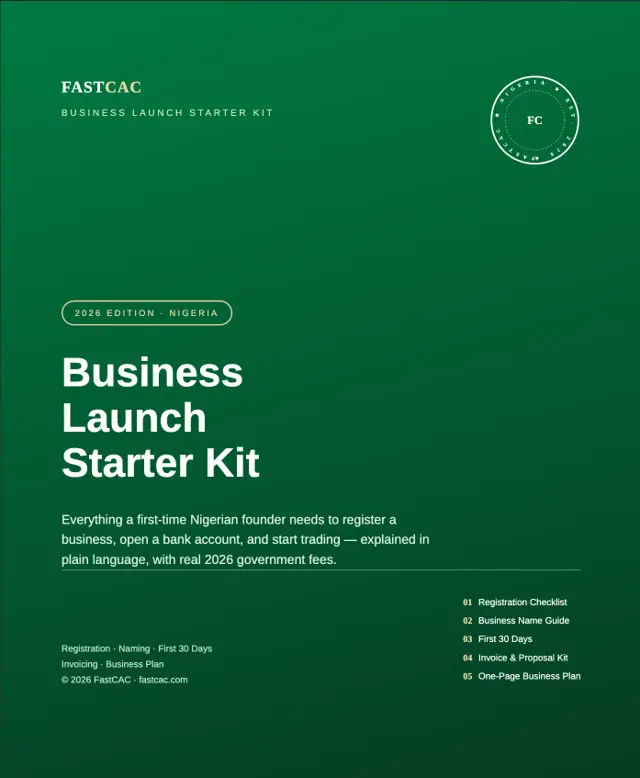
The 2026 Business Launch Starter Kit
From CAC Registration to your first 30 days—get the exact guides and templates you need to launch without the stress.
Confused by TIN, VAT, and government fees? Don't let paperwork delay your business. This kit explains everything in simple, everyday English so you can avoid costly mistakes, open your corporate account, and bill clients like a pro. No lawyer needed.
What You Get In The Kit:

FastCAC Legal Team
Our legal experts specialize in CAMA 2020 compliance and helping Nigerian startups choose the most efficient path to registration.