How to Register a Private School in Nigeria
A complete guide for educators transitioning from illegal operations to a formal, licensed educational institution.

Educational entrepreneurs in 2026 are finding that informal schooling is no longer viable. Between tighter bank KYC requirements and strict state inspections, the days of running a school as a simple "Business Name" are over. To issue certificates and attract partners, your school must be a corporate entity.
The Nigerian private education sector is booming—millions of children attend private primary and secondary schools—but regulators are cracking down on unregistered or improperly structured institutions. Parents and employers increasingly demand to see formal corporate registration before trusting a school with their children's future.
1. Why Schools Must be Companies (Ltd)
The CAC no longer allows schools to register as Sole Proprietorships (Business Names). A school is considered a large-scale institution with public responsibility. Therefore, it must be registered as a Private Limited Liability Company.
- Perpetual Succession: The school continues even if the founding owner changes or passes away—critical for long-term institutional credibility.
- Contractual Power: The Ltd can sign supply contracts, rent leases, and employment agreements in its own corporate name.
- Mandatory for State Licensing: All state Ministry of Education departments require a Certificate of Incorporation before issuing an operational permit.
- Banking Access: School fees must be collected into a corporate account, which requires an Ltd structure for formal financial operations.
2. The TRCN Board Requirement
To register a school company, the CAC often requires that at least one of the Directors must be a certified teacher registered with the Teachers Registration Council of Nigeria (TRCN).
Founder vs Director
If the founder is not a qualified teacher, they must appoint a qualified director or principal with TRCN certification during the CAC filing process to satisfy regulatory standards. This person becomes a legal director of the company and must be properly onboarded.
TRCN certification requires a recognized teaching qualification (NCE, PGDE, B.Ed, or M.Ed) plus registration with TRCN and payment of the annual practicing fee. If your school is for pre-primary (nursery) education, these requirements may vary by state—check with your State Ministry of Education for the specific guidelines applicable to your school level.
3. Ministry of Education Approval
CAC registration is the first hurdle. The second is the Operational Licensefrom your state's Ministry of Education (e.g., Lagos State Ministry of Education, SUBEB, or Universal Basic Education Commission). They will conduct a physical inspection of your facilities and evaluate:
Facility Standards
Classroom size per student (minimum 1.2 sqm), ventilation, natural lighting, playground space, and fire safety exits. Schools in converted residential buildings often fail this inspection.
Curriculum Compliance
Proof that your teaching content aligns with the National Policy on Education and the NERDC-approved curriculum for the applicable school level.
Teacher Qualifications
A teacher-to-student ratio that meets state standards. All teaching staff must have minimum NCE qualifications for primary schools.
Sanitation & Health
Separate toilet facilities for boys and girls, clean water access, and a school nurse or first aid station.
4. Step-by-Step Registration
Follow this roadmap to register your school company:
Name Search & Reservation
Reserve a name that reflects education (e.g., Academy, High, College, Institute). Verify availability on the CAC portal.
Draft a School-Specific MEMART
Adopt Articles of Association specifically designed for an educational services company. The Objects Clause must explicitly mention educational services, nursery, primary, or secondary schooling.
Appoint Directors (Including TRCN-Certified Educator)
Distribute shares and onboard directors. Ensure at least one director has a verifiable TRCN number.
Pay Statutory Fees Online
Pay stamp duties and CAC filing fees through the official CAC portal via Remita.
Download Certificate of Incorporation & TIN
Upon approval, download your Certificate of Incorporation and Tax Identification Number.
Apply for State Ministry of Education Permit
Submit your CAC documents, MEMART, facility inspection request, and teacher credentials to your State Ministry of Education for an operational license.
5. Naming Your School Company
The CAC has specific naming guidelines for educational institutions. Terms like "University," "Polytechnic," and "College of Education" are reserved for institutions accredited by the National Universities Commission (NUC) or NBTE and cannot be used by a private Ltd company without prior approval from those bodies.
For private primary and secondary schools, terms like "Academy," "School," "High School," "Institute," and "Learning Centre" are generally acceptable. Always confirm name availability on the CAC portal before committing to a name.
6. Timeline and Costs
| Stage | Timeline | Approx. Cost |
|---|---|---|
| CAC Ltd Registration | 5–10 business days | ₦15,000 – ₦30,000 |
| Ministry of Education Permit | 4–12 weeks (varies by state) | ₦20,000 – ₦100,000 |
| TRCN Registration (per teacher) | 2–4 weeks | ₦12,000 – ₦20,000 |
Conclusion
Registering your school as an Ltd company with the CAC is not just about compliance—it is about building a credible, durable educational institution. By ensuring TRCN-certified leadership and following the Ministry of Education approval process, you lay the foundation that parents, regulators, and potential investors will trust. FastCAC’s AI-automated platform can handle your Ltd registration end-to-end — verifying your details and documents and tracking your status until your certificate arrives — so you can focus on what you do best: educating the next generation. Also see our guide on Business Name vs. Ltd for a deeper understanding of why the corporate structure matters.
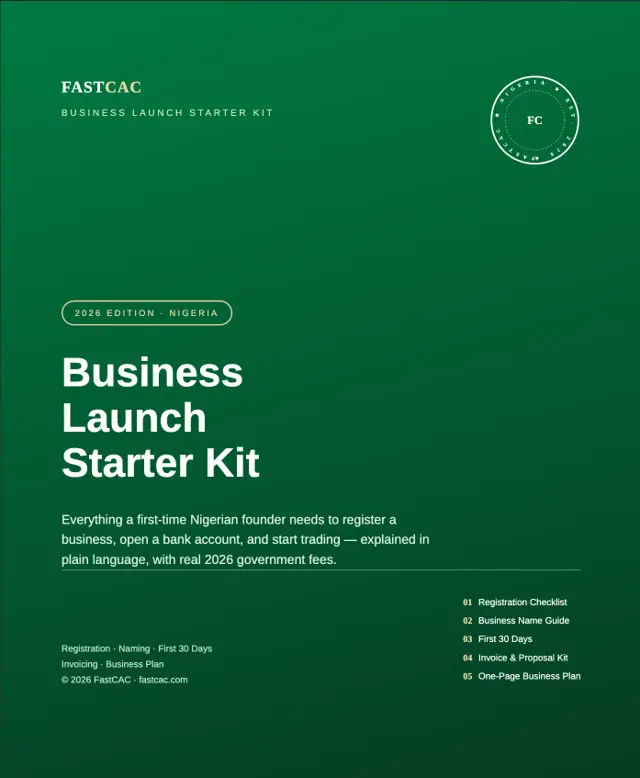
The 2026 Business Launch Starter Kit
From CAC Registration to your first 30 days—get the exact guides and templates you need to launch without the stress.
Confused by TIN, VAT, and government fees? Don't let paperwork delay your business. This kit explains everything in simple, everyday English so you can avoid costly mistakes, open your corporate account, and bill clients like a pro. No lawyer needed.
What You Get In The Kit:
FastCAC Legal Team
Our team helps educational founders navigate the intersection of corporate law and state-level educational mandates.