How to Register an NGO in Nigeria (Incorporated Trustees)
NGOs, foundations and associations register with CAC as Incorporated Trustees. Here's who can be a trustee, what the constitution needs, and what happens after.
About FastCAC: FastCAC isn't a CAC agent. It's a registration platform built by DigitalAbode (RC 8561321), a registered Nigerian technology company, that files your application directly with CAC.
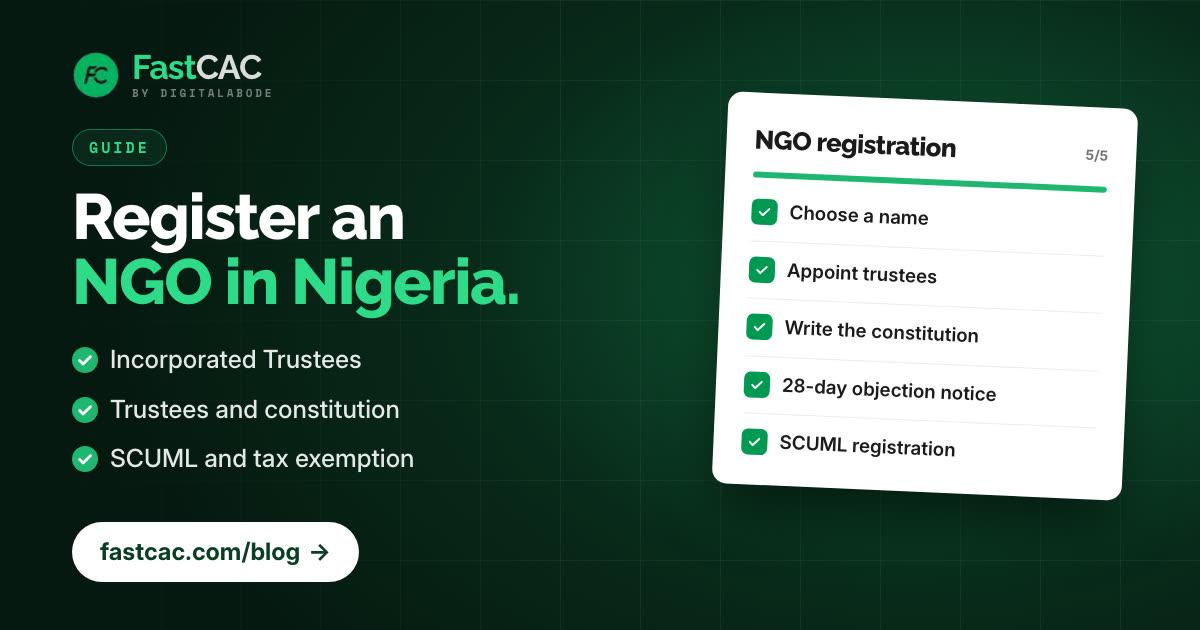
If you're starting a foundation, a charity, an alumni association or a community development group, you don't register a business name or a company. You register the group's trustees with the Corporate Affairs Commission (CAC) as Incorporated Trustees, and the group becomes a legal body that can own property, open a bank account and sign agreements in its own name.
It's a slower and more paper-heavy process than registering a business. This guide explains each part so you know what you're preparing for. It's general information, not legal advice.
Straight answer first:FastCAC doesn't file Incorporated Trustees registrations. We currently register business names. You can still use our free CAC name checker to test your NGO's name against CAC's register, and ask us questions on WhatsApp.
1. Incorporated Trustees Explained
Part F of the Companies and Allied Matters Act (CAMA) 2020 lets a community or body of people bound together by a common purpose, such as religious, educational, literary, scientific, social, development, cultural, sporting or charitable aims, appoint trustees and register them as a corporate body. Once CAC issues the certificate, the trustees hold property and act for the association as one legal person with perpetual succession.
Incorporated Trustees
The usual route for NGOs, foundations, associations, clubs and religious bodies. No shares, no owners. Income must go to the association's aims, not to members.
Company limited by guarantee
Another non-profit structure under CAMA, with directors and members instead of trustees. It needs extra approvals before CAC will register it. Some larger organisations choose it, but most NGOs use Incorporated Trustees.
2. Choosing Your Trustees
Trustees are the people who legally hold the NGO's property and answer for it. Plan for at least two. Under section 826 of CAMA 2020, a person can't be a trustee if they are:
- a minor
- found by a court to be of unsound mind
- an undischarged bankrupt
- convicted of an offence involving fraud or dishonesty within five years of the proposed appointment
Each trustee provides a valid ID, passport photograph, signature and contact details, and swears a trustee declaration before a Commissioner for Oaths or Notary Public. Pick people who are committed for the long run: changing trustees later means another filing with CAC.
3. The Constitution
An NGO doesn't file a memorandum and articles. It files a constitution. Section 827 of CAMA 2020 says it must state the association's name and its aims and objects, and must provide for how trustees are appointed, their powers, duties and tenure, and how they're replaced. In practice a good constitution also covers:
- membership, meetings and how decisions are made
- how the NGO's money is managed and accounts audited
- a clause that income and property go only to the NGO's aims, never shared among members or trustees
- how the constitution can be amended
- what happens to remaining assets if the NGO is dissolved
Hold a meeting to appoint the trustees and adopt the constitution, and keep signed minutes. CAC asks for them with the application. A lawyer who handles NGO work can draft or review the constitution; it's the document most likely to draw a CAC query.
4. The Registration Process
- Check and reserve the name.Under CAMA the registered name carries the words "Incorporated Trustees of" before your NGO's name. Test your options on the CAC name checker (it searches Incorporated Trustees too) before you pay to reserve one on CAC's portal.
- Hold the founding meeting to appoint trustees and adopt the constitution.
- Get each trustee's declaration sworn.
- File the application on CAC's portal, uploading the constitution, minutes, trustee details and declarations, and pay the filing fee.
- Publication and the 28-day objection window (next section).
- Answer any CAC queries. They usually concern the constitution or the trustee documents.
- Download the certificate once CAC approves. Certificates are issued electronically.
CAC's fees change, so we don't quote them here. See our CAC registration cost guide and confirm the current figure on CAC's portal before you pay. For the general documents CAC expects from individuals, see CAC registration requirements.
5. Publication and Objections
This is the step that makes NGO registration slow. Section 828 of CAMA 2020 requires the application to be published in two daily newspapers circulating where the association is based, at least one of them national. The notice invites objections, and anyone who objects has 28 days from the last publication to send CAC their grounds.
Who places the notice?
The law says CAC causes the publication. In practice, applicants have often been asked to place the advertisements themselves, and CAC has said it wants to take the job over. Because this has shifted, check the current instructions on CAC's portal or with CAC when you file, and keep copies of any publication you place.
If no objection comes in, or CAC rejects any that do, CAC can approve the application and issue the certificate. Plan for about two months from start to certificate, and longer if CAC raises queries.
6. SCUML Registration
The Special Control Unit against Money Laundering (SCUML), under the EFCC, keeps a register of non-profit organisations. In December 2023 the Central Bank of Nigeria told banks to get evidence of SCUML registration from non-profits before opening accounts for them, so most NGOs register with SCUML straight after CAC.
- Registration is free. The EFCC has repeatedly warned people not to pay anyone for the certificate itself.
- Expect to upload your CAC certificate, constitution, trustee details and Tax ID.
- Apply on SCUML's own portal. Processing times vary.
7. Tax Exemption Basics
Nigerian tax law has long exempted the income of organisations doing charitable, educational or religious work of a public character, provided the income isn't from a trade or business. The Nigeria Tax Act 2025 keeps that exemption. Three things to know:
- It's conditional. Income from commercial activities, like selling goods or renting out property, can be taxed.
- You still register for tax. Under the 2025 reforms the old TIN is being replaced by a unified Tax ID under the Nigeria Revenue Service (NRS, formerly FIRS). See how to get your Tax ID after CAC registration.
- Staff are still taxed. If you pay employees, you deduct and remit PAYE like any employer.
A tax adviser can tell you how the exemption applies to your activities.
8. After Registration
- Open a bank account in the Incorporated Trustees' name (CAC certificate, constitution, SCUML certificate and trustee IDs).
- Keep proper books and get accounts audited.
- File changes of trustees, name or objects with CAC when they happen.
- File annual returns with CAC as required.
A recent court ruling to watch
In a decision reported in October 2026, the Court of Appeal upheld a Federal High Court judgment that sections 839 and 842 to 848 of CAMA 2020 are unconstitutional. Those sections include CAC's power to suspend trustees and some of its oversight and filing rules for Incorporated Trustees. Exactly how CAC applies this is still settling, so if you run an NGO, ask a lawyer which filing obligations still apply to you.
For the general picture of what comes after CAC, see our post-registration compliance guide. It's written for businesses, but the tax and banking steps overlap.
NGO Registration FAQs
Can I register an NGO as a business name?
No. A business name is for trading. An NGO, foundation, association or club that won't share profits among its members registers as Incorporated Trustees under Part F of CAMA 2020. Some non-profits use a company limited by guarantee instead, which is a different route with its own approvals.
How many trustees does an NGO need?
Plan for at least two. Each trustee must be an adult, of sound mind, not an undischarged bankrupt and not convicted of an offence involving fraud or dishonesty in the last five years. Each one swears a declaration before a Commissioner for Oaths or Notary Public.
Is newspaper publication still required?
CAMA 2020 section 828 still requires the application to be published in two daily newspapers, at least one national, with 28 days for anyone to object. How that's arranged in practice has changed over the years, so confirm the current CAC checklist when you file.
How long does NGO registration take?
Longer than a business or company. The 28-day objection window alone sets a floor of about a month, and with name approval, sworn declarations and possible queries, about two months is a realistic plan. It can take longer.
Does my NGO need SCUML registration?
In practice, yes. A December 2023 Central Bank of Nigeria circular tells banks to get evidence of SCUML registration from non-profit organisations before opening accounts for them. SCUML registration is free.
Is a registered NGO tax-exempt?
Income of organisations carrying on charitable, educational or religious activities of a public character is exempt, as long as it doesn't come from a trade or business. It isn't automatic: you still need a Tax ID, and income from commercial activities is taxable.
Does FastCAC register NGOs?
Not yet. FastCAC currently files business name registrations. You can check your proposed NGO name with our free CAC name checker, which searches Incorporated Trustees too, and ask us on WhatsApp if you have questions.
Questions about registering your business?
Ask us on WhatsApp. It opens with a message ready to send, and we answer there.

FastCAC Legal Team
Helping Nigerians understand CAC registration, from business names to Incorporated Trustees.