How to Open a Corporate Bank Account in Nigeria (2026 Guide)
Your CAC certificate is just the start. Here is how to legally manage your business finances in 2026.

Mixing personal and business finances is a recipe for disaster. In 2026, a corporate bank account is not just a professional touch—it's a legal requirement for certain types of businesses and a prerequisite for virtually all business loans, grants, and enterprise contracts in Nigeria.
Once your CAC certificate is issued, opening a corporate account should be your very next step. Without one, you cannot receive bank transfers for business purposes, pay staff salaries through payroll systems, or qualify for CBN intervention funds that are reserved exclusively for registered businesses with verifiable corporate accounts.
1. The Document Checklist
Banks have become stricter in 2026 due to updated KYC (Know Your Customer) and AML (Anti-Money Laundering) regulations from the CBN. Prepare these documents before visiting any bank to avoid multiple trips:
Or Certificate of Registration for Business Names
Auto-generated on your CAC certificate since 2021
Required for companies in designated non-financial businesses
For Ltd companies authorizing account opening
Company constitution document
NIN and BVN for all directors/signatories
Not older than 3 months for the office address
Recent photos of account signatories
2. Top Banks for Startups in 2026
Not all banks are created equal. Some have positioned themselves specifically for the "Startup Economy" with lower maintenance fees and better technology integrations. Here is how the major players stack up:
Zenith Bank & GTBank
Best for businesses that need physical branch presence nationwide, established payment gateway integrations, and credibility with enterprise clients. Processing time: 5–10 business days.
Stanbic IBTC
Leading in digital onboarding for new businesses. Offers a Business Plus Account with no minimum operating balance for the first 6 months.
Access Bank & UBA
Strong trade finance capabilities. Ideal for import/export businesses. UBA also offers pan-African accounts for businesses operating in multiple African countries.
3. Digital vs. Traditional Banking
The rise of digital-only business banking has been one of the biggest financial developments in Nigeria over the past three years. Neobanks offer almost instant account opening if you have your CAC documents ready, with significantly lower overhead fees.
Moniepoint Business
Account in 24 hours. Built-in POS and payment collection. Ideal for retail businesses.
Kuda Business
Zero account maintenance fees. Free transfers, and easy integration with e-commerce platforms.
Brass (Brass.co)
Built specifically for Nigerian SMEs. Offers expense tracking, team cards, and accounting integrations.
Caveat:Digital banks may not be accepted by all enterprise clients or government agencies. Many procurement departments require a "tier-1" bank account (CBN classification). A dual-banking strategy—one neobank for daily operations and one traditional bank for formal transactions—is what many Nigerian startups use in 2026.
4. The TIN Requirement
You cannot open a corporate account without a Tax Identification Number (TIN). In 2026, the CAC automatically generates a TIN for most new registrations, which you will find printed on your certificate or available in your CAC online dashboard. Ensure this TIN is verified on the FIRS (Federal Inland Revenue Service) portal before heading to the bank, as some banks cross-reference it during their KYC process.
TIN Verification Tip
Visit tin.jtb.gov.ng to verify your TIN status before going to the bank. If your TIN shows as unverified or inactive, contact the nearest FIRS office with your CAC certificate to have it activated.
5. Common Mistakes to Avoid
- ✗Going to the bank without all documents.
Banks will send you home if even one document is missing. Use the checklist above and confirm with the specific bank beforehand.
- ✗Using a personal account for business purposes.
This creates a compliance nightmare during tax filing and can disqualify you from business loans that require clean corporate transaction records.
- ✗Ignoring the SCUML requirement.
If your business falls under SCUML's Designated Non-Financial Business (DNFB) category—legal services, real estate, car dealers, travel agencies—you must obtain a SCUML certificate before the bank will open your account.
6. How Long Does It Take?
The timeline varies significantly by bank. Digital banks (Kuda, Brass, Moniepoint) can activate your account within 24–48 hours of document submission. Traditional tier-1 banks typically take 5–10 business days for account activation after submitting all required documents.
Pro tip: Submit your account opening forms and documents immediately after receiving your CAC certificate—do not wait. Some banks require a notarized copy of certain documents, which can add extra days. Also check out our post on post-registration compliance steps for other important actions to take after your CAC certificate is issued.
Conclusion
Corporate banking is a vital step in professionalizing your venture. Choose a bank that matches your business model—digital for agility, traditional for enterprise credibility, or both. Prepare your documents in advance, verify your TIN, and use a checklist approach to avoid multiple bank visits. Reach out to the FastCAC team if you need help gathering or preparing your documentation.
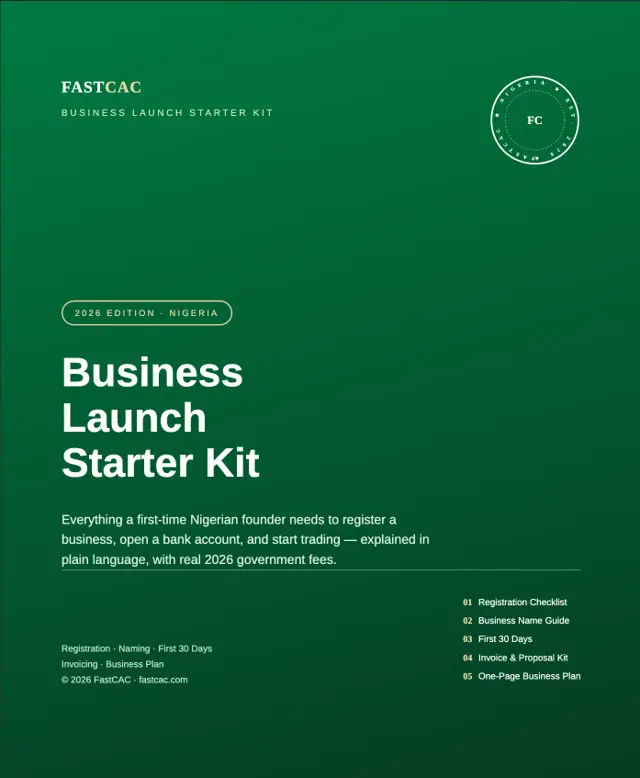
The 2026 Business Launch Starter Kit
From CAC Registration to your first 30 days—get the exact guides and templates you need to launch without the stress.
Confused by TIN, VAT, and government fees? Don't let paperwork delay your business. This kit explains everything in simple, everyday English so you can avoid costly mistakes, open your corporate account, and bill clients like a pro. No lawyer needed.
What You Get In The Kit:

FastCAC Finance Team
We help entrepreneurs navigate the Nigerian financial system, from account opening to tax compliance.